Journal

Blog - Page 54

Thoughts on photography, technology, music, and creative work.

5 Things You Didn't Know About Me

Well, I've been too busy to blog recently due to several large projects that I'm working on concurrently, but I figured I would respond to this 5 things meme, as Siel of Green LA Girl tagged me.

  1. I lived in South Africa for a year when I was 6 years old.
  2. I only drink coffee on ice (and some times it's not even fair trade!)
  3. I make my cats dance, but I think they like it.
  4. My first job out of High School was designing rave flyers.
  5. I want to retire in Santa Fe, New Mexico.

I am tagging: Peneloper, Eric, Celia, Jim and Ed.

December 17, 2006 Read more

NetIQ Sold My Email Address To Spammers

The unique throwaway email address that I used only for NetIQ was eventually sold to a spam list. Shame on you NetIQ, I don't think you've adhered to your own privacy policy.

... we want you to know that NetIQ is not in the business of selling or renting individuals' personal data to other companies for marketing purposes.

November 30, 2006 Read more

Obligatory Wife Photos

Last weekend, the wife and I drove up to Angel's Gate and did a portrait session with the beautiful setting sun as our backdrop. I used two strobes, at roughly 45 degrees and 10 feet back from Penelope. The strobes were bounced off of white umbrellas raised up about 8 or 9 feet. The light ratio was 1:4 between key and fill. I triggered the flashes with my trusty set of PocketWizard Plus IIs and metered with my Sekonic L-558R. Shot with a Canon EOS 30D and an EF 85mm f/1.2 L. My wife is a beautiful and patient model.

Penelope and sunset

Penelope

The key flash was still recycling in the second shot, but I still love it.

November 7, 2006 Read more

APEX Electronics : Dorkbot Socal

After growing up in the Bay Area, I attended High School in Santa Fe, New Mexico. One day my father, who worked as a programmer at Los Alamos National Laboratory, brought me to, and later got me a job at, a nerd's paradise called The Black Hole. I ended up working there for 3 summers and I think it was probably my favorite job ever, although it only paid $5 an hour. Many of the hours I worked were directly exchanged for random bits of junk, much of which I still have, to my wife's elation, stored away in boxes in our storage closet.

When I saw heathervescent's post about the upcoming Dorkbot Socal trip to APEX Electronics, I knew I had to go. The night before the trip I shot an email out to an especially geeky list that I run and CHS responded that he wanted to come along. We arrived a bit late at Machine Project, and Tom Jennings was mostly finished talking about what to expect. I mentioned my previous employment at The Black Hole and he told me that he make a road trip there every year, saying that it was one of his favorite places in the world.

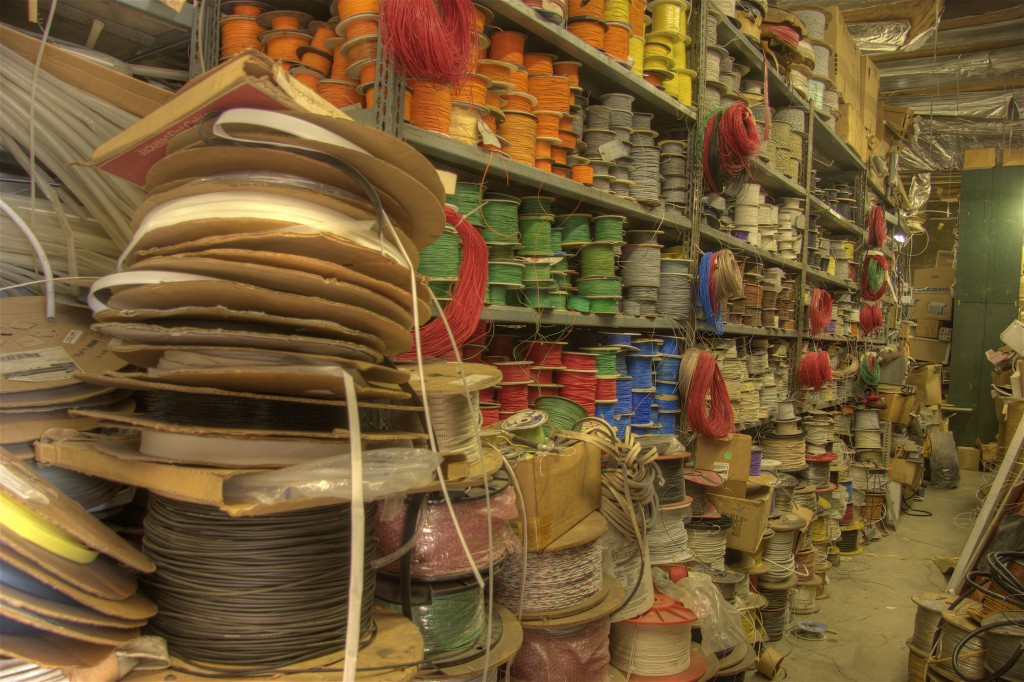
After a short drive to the highly industrial Sun Valley, we made our way in to the wonderfully techno-detritus rich warehouse known as APEX Electronics. I immediately pulled out my camera, set up my tripod and began photographing the narrow aisles packed high with everything from oscilloscopes to capacitors to vacuum tubes.
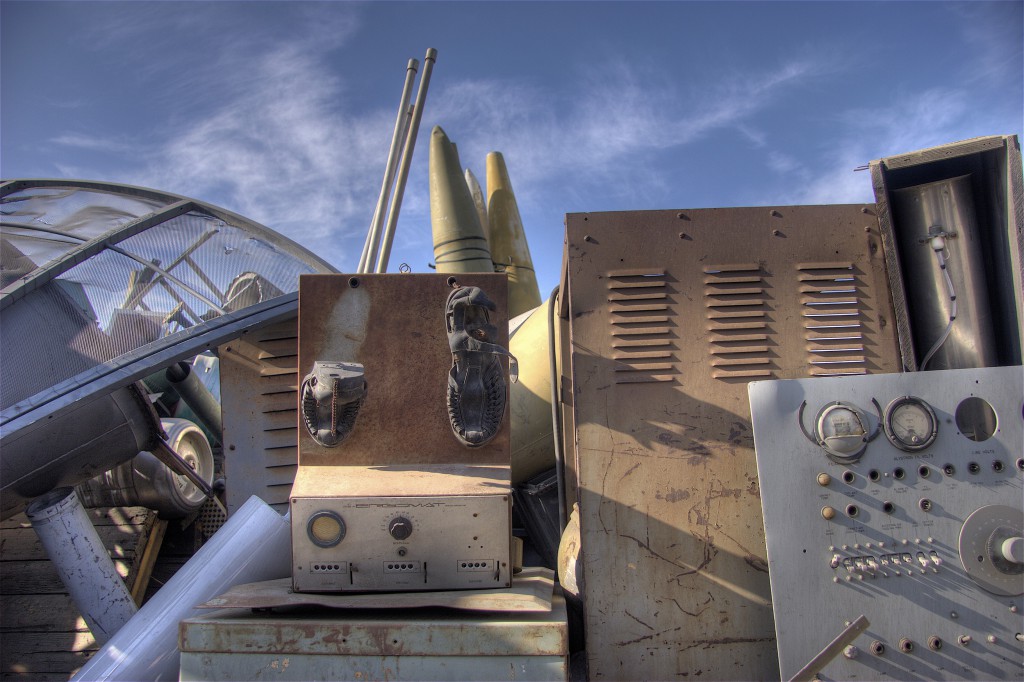
Shoe Tester

Colorful Wire

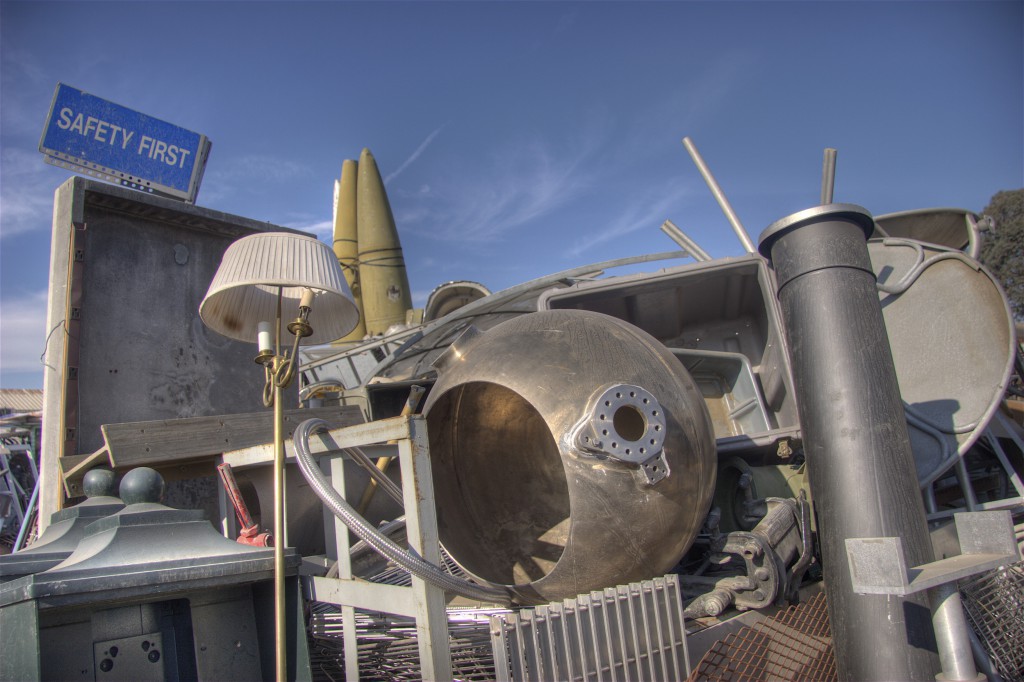
Safety First

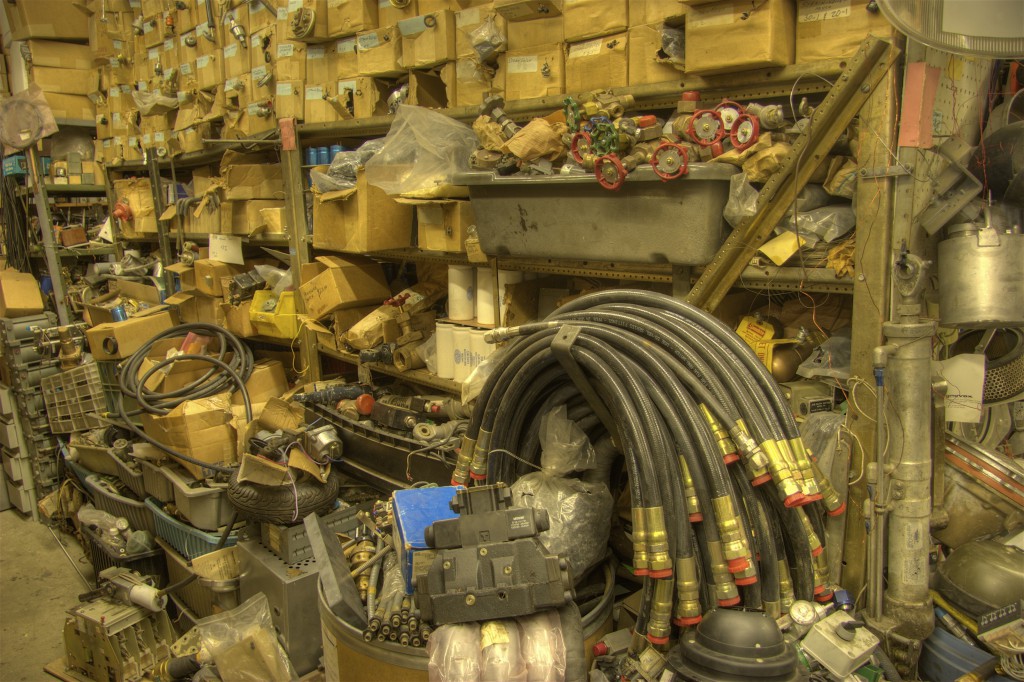
Hoses and Valves

APEX reminded me of a 1/10th scale model of The Black Hole, with less nuclear research equipment and more audio recording, broadcast and aviation gear. The organization of APEX is at least an order of magnitude better than The Black Hole, but I guess that having one tenth the amount of junk makes that possible. I should be careful about calling the contents of APEX or TBS junk, as they say, "one man's trash...", and also the collectors of said equipment seem to develop an emotional attachment to their toys.

Most of the aisles held boxes full of components, with a single version taped to the front of the box. Some of the more valuable gear like the microwave wave guides, windows and transmitters were locked up behind glass, which the owner, Don, was nice enough to open for me so I could take a photo. Tom mentioned that one aisle had collapsed in an earthquake almost 2 decades ago, and had yet to be cleaned up.

Outside there were towering piles of scrap aluminum, kegs, airplane wings, cable, and junk. I especially enjoyed the pile of "Safety First" signs that were haphazardly piled together along with what appeared to be a bomb, but was probably an airplane fuel tank.

It is a good thing that I am short on physical space in my loft, otherwise I surely would have purchased more than the $1 clamp that I picked up. If you are building a robot or some other fun project, this would be a great place to pick up those hard to find parts you need. If you are a junk collector, but you don't want to blow all your hard earned money in one place, you should avoid this place at all costs.

Full gallery here.

Update Heathervescent's flickr photo set can be found here, Zoetica's can be found here (Thanks thedaniel).

November 5, 2006 Read more

My Field Lighting Setup

As I mentioned in the last few posts that I just posted in a spurt of posting activity, that I am building up a portable, battery powered lighting setup. I didn't feel like spending $3,000+ on a "real" head / pack lighting system as of yet, although some day I will end up buying one, most likely the Dyna-lite setup at first, but then eventually a Profoto rig. Portability is probably the biggest factor for me, as I don't have a studio to shoot in, so nearly all my work will be done on location. Many of the locations I plan on shooting will be either outdoors, or in places where lack of line voltage would be a limiting factor.

I already possessed a Quantum Turbo 2x2, which I've been very happy with in combination with my Canon Speedlite 580EX. I didn't want to buy another 580, because I didn't plan on using E-TTL for my portrait lighting, so after some research I decided to pick up the very moderately priced Sunkpak 120J Auto Pro, which is a bare bulb flash, that can be powered directly by an HV power pack, without needing any other batteries, unlike the 580EX.

Unfortunately Adorama sent me the TTL version of the 120J, which didn't come with the sync adapter, so I bought the standard shoe adapter that has the sync connector. This really isn't what I wanted as I will never actually be mounting it on a hot or cold flash shoe. I am trying to work it out with Adorama now, I need the flash for some work I have coming up, and they want me to buy the right one, even though it was their mistake in sending me the wrong one, and then send back the wrong unit when the new one comes. I feel like they should take the hit, send me the new one and I'll send them back the wrong when when I have received the correct model. I will see what happens, but I have a feeling that I am going to have to do it their way, which is too bad.

So as I wrote about earlier, I am using the 2 PocketWizard Plus II transceivers to trigger the flashes, which I am bouncing off or through a couple of convertible Photoflex umbrellas, that are sitting atop one Photoflex stand and one Avenger Stand. The third PW is on atop my camera in the hot shoe and I am using the Sekonic L-558R to meter the scenes. I also just picked up a couple of used C-Stands, and although they're heavy as hell, they're very sturdy and will be great to hold my convertible reflector and down the road flags, scrims, fingers, dots, etc. I also bought another Quantum battery, this one a Turbo Z. I have some sand bags and cases for the stands in the mail. In the future I will be buying some Chimera softboxes

My first results have come out quite well, but I still have a long way to go, and I am planning on taking some lighting classes, and maybe attending a workshop or two.

October 26, 2006 Read more

Sekonic L-558R Dualmaster

Now that I'm building up my studio / location lighting kit, I can no longer rely on my trusty Canon 580EX's built in E-TTL system to do the dirty work of exposure calculation for me on the fly. E-TTL is great, don't get me wrong, but it only works when the flash is either on camera, off camera with the off camera flash cord or triggered with Canon's IR remote, which only works if your flash is facing you and you were within a fairly distance from your flash and within a fairly narrow angle. I logically decided that I needed a flash meter.

There are plenty of flash meters out there, from the trusty analog flash meter to high end digital meters with built in radio slave transmitters. I thought of it, like many folks think of tripods, that you can start out with the cheapest you can get, but in the long run you'll most likely end up spending more on upgrades until you get to where you want to be, than if you just shell out the money for the good stuff up front. So I decided on the latter, and shelled out the roughly half grand on the Sekonic L-558R.

The Sekonic L-558R is an easy to use (once you've read the manual) and sturdy flash meter, that also functions as an incident and reflected spot meter. The meter will read your flash in both incident and reflective modes, I think it is pretty cool that you can take a spot meter flash reading, but I'm sure there are other units that can do the same thing. As I mentioned before, the meter has a PocketWizard module that is built into the L-558R which allows you to trigger your flashes directly from the meter without using a sync cord.

One of the features that I find most useful is the ability to meter you key light, and then meter your fill light, and the meter will give you the difference between the two in EVs. This is an easy way to figure out the ration between your key and fill. You can also fire a series of flashes, storing each one in memory, and then get either a cumulative or average reading.

The meter itself is very compact, fits nicely in your hand and feels solid and well built. I would prefer the device didn't require the expensive 3V lithium battery that could be tough to procure in a bind, but I guess they decided they could make it a tiny bit more compact if they used the 3V lithium as opposed to using 2 AAs or AAAs. The only other issue I have with the meter isn't actually related to the meter, but to an older spot meter that I've been borrowing from my mother to use with my Mamiya RB67 setup, which was "modified" by Zone VI to have a nice little movable zone scale on the side, which makes ensuring that my exposure contains the data I want much easier. I know that I can just take an EV reading and put that into either my mental Zone chart, or I can put it on my handy Zone worksheet, but the little paper ring on the manual scale was really nice.

Before I bought the L-558R I found out that Sekonic is coming out with a new meter, specifically tailored to digital cameras, called the L-758DR. The 758DR allows you to load 4 custom profiles into the meter via a USB cable so that the meter will "respond to light exactly like your digital camera or type of film." Another very cool and helpful feature is the ability of the meter to warn you if you are outside the dynamic range of your medium. The 758DR is also extremely sensitive, down to f-2.0! I may or may not upgrade when it comes out. The 558 has all the features I really need and many more.

October 26, 2006 Read more

The Joy of PocketWizards

After researching the ideal flash slave system for months I settled on the PocketWizard system. In reality, there wasn't much of a question in my head as to which system I was going to buy, this may seem a bit silly, but they had me at the ads. Their full page ads run every month in Shutterbug and many other photo mags, and their system is built in to several competing brands of lights including Profoot, Dyna-lite, Speedotron and Norman. There is fairly solid consensus in the professional photo industry that the PW system is the best you can get. The only other serious player for radio slaves is Quantum, but they just aren't as slick.

I just picked up a set of 2 Pocketwizard Plus II transceivers from Adorama and a third unit from Samy's Camera and they are nothing short of wonderful. Not only are they absolutely simple to operate, they just plain work. After about 500 shots fired, I've never had a single misfire. They are light-weight, compact, and as far as I can tell, very sturdy. They have a range of roughly 1500' and they will receive and rebroadcast signals so that range is really only limited by the amount of units you own. I recommend these units without reservation.

October 26, 2006 Read more